
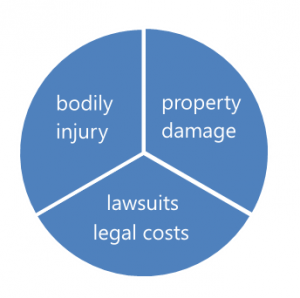
General liability insurance protects a company’s assets and pays for obligations. For example, it covers medical costs incurred if someone gets hurt on your property or when there are property damages or injuries caused by you or your employees. Liability insurance also covers the cost of your legal defense and any settlement or award should you be successfully sued. Generally, these include compensatory damages, non-monetary losses suffered by the injured party, and punitive damages. General liability insurance can also protect you against any liability as a tenant if you cause damage to a property that you rent, such as by fire or other covered loss. Finally, it can also cover claims of false or misleading advertising, including libel, slander, and copyright infringement.
Getting liability insurance is a wise investment that doesn’t cost much – annual premiums could range from $425 and up on your line of business and coverage needs. That’s certainly a lot less than the thousands, if not millions, of dollars you may need to spend fighting your case in court. General liability insurance can be purchased on its own, but it can also be included as part of a Business Owner’s Policy (BOP) which bundles liability and property insurance into one policy. If you have a BOP, check it to see what your liability coverage limit is. You may find that it is quite low, in which case you may need additional coverage through a separate policy. There are specific liability products catered to contractors that you can add some tools and equipment coverage making it into a BOP that costs the same if not better than just getting liability coverage by itself. The coverage you need depends on the type of business you are in and the perceived risk associated with it.
How general liability insurance works is the same as many insurance plans, your general liability policy will outline the maximum amount the insurance company will pay against a liability claim. So, if your small business gets sued for $250,000 for medical costs associated with an injury caused by a worksite hazard, plus an additional $100,000 in legal fees, but your coverage maxes out at $300,000, then you are responsible for paying the difference of $50,000. If you are on the higher end of the risk scale and already have general liability insurance, you can also opt for umbrella insurance that increases your coverage limits. This will cover you in situations in which you’re worried that your existing coverage won’t cover all your costs should someone file and win a claim against you. The most commonly asked limit we have found is $1,000,000 per occurrence with a $2,000,000 aggregate.

If an incident occurs that may lead to a claim, you should notify your insurance company or agent immediately. Be prepared to explain what has happened in detail including the time, date, the names of any witnesses, and any other pertinent information.
Remember General Liability Insurance just like all other kinds of insurance are designed to help you in a time of need. Make sure you review your policies with your insurance agent on a regular basis. This can help you make sure you are up to date on coverages and that you have the limits that best suit your business. This is important because your business has probably changed a great deal from the first time you took a policy out when you open your doors.





 These workers’ compensation systems are administered by each individual state and not the federal government. Because of this, each state provides the system a tad bit different. Wisconsin was the first state to administer a workers’ compensation system in the year 1911. Mississippi was the last state to come around to the exclusive remedy in 1948.
 The term ‘
 As time has passed and work environments have changed so has the opinion of many in the business community about the need for an exclusive remedy in todays’ business climate. A few states have removed workers compensation as a requirement for some types of businesses. A few other states have proposed the idea, but are still in a wait and see approach. At this time Texas and Oklahoma re the only states to implement what is referred to as an Opt-out program. This is a program where if the business qualifies they can elect not to carry coverage and provide an alternative to what most states give through the workers comp exchanges. Both have in place certain minimum standards that are similar to those standards required under most workers compensation systems. Opponents of these system frequently critique that there are very strict reporting policies put on the responsibility of the employee. In the system set forth by Oklahoma employees must report the injury to management within 24 hours or they may not be eligible for coverage. Most states are sitting in a wait and see approach and depending on the success or failure of these states will determine the future of the workers’ compensation system.